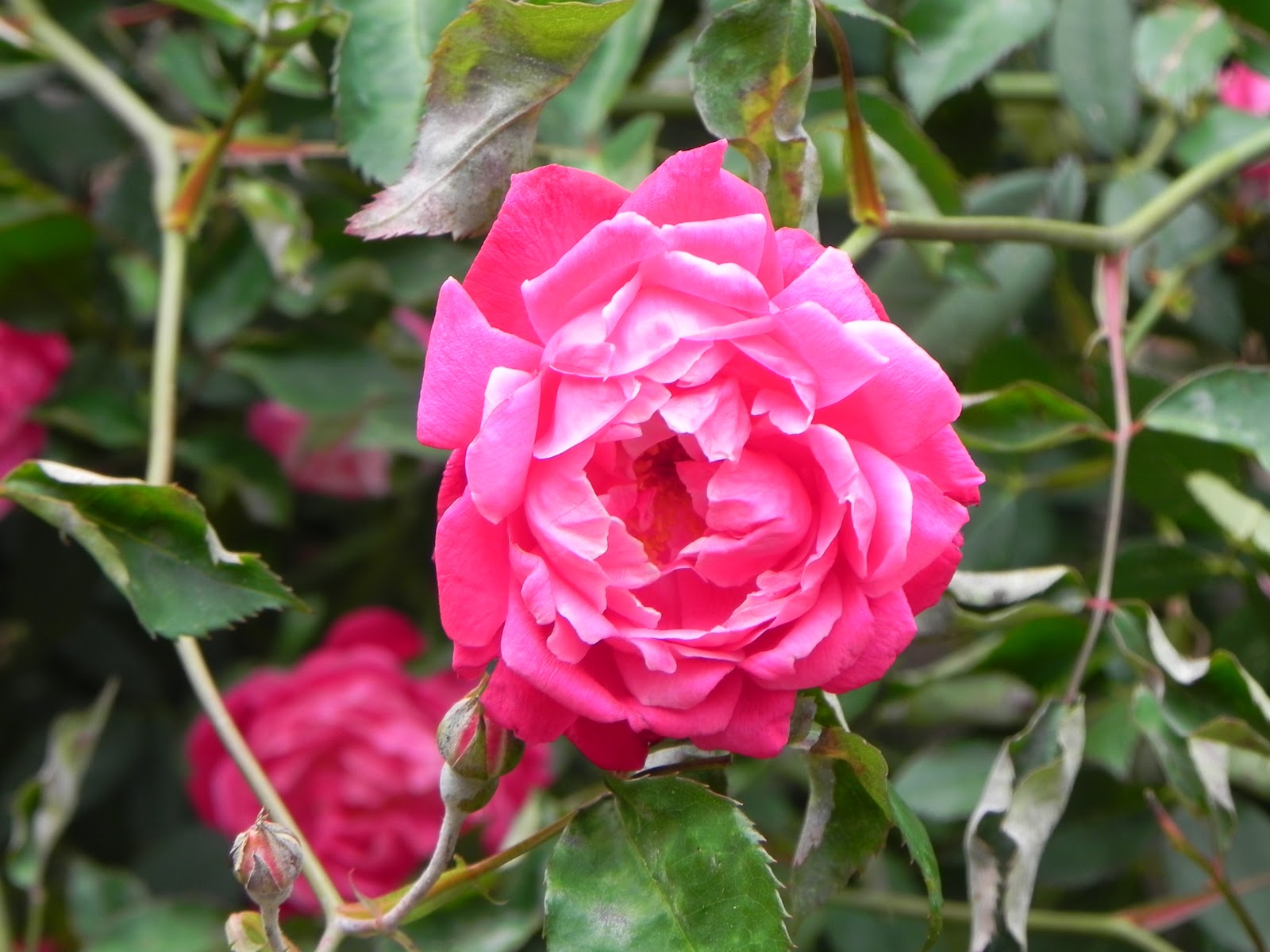
Today's theme has seemed to be all about water, that ever-present element that I am so drawn to.
First, a friend and I went to Waterfront Park, a local park located along the Cooper River. I recently bought a new digital camera - a Nikon Coolpix P100, and I wanted to experiment with it. All of the pics shown within these posts, as well as my new profile pic, are pictures that were taken today with that camera.
One of the more beautiful things about this park is the water fountain. It arcs beautifully in streams from the edges into the center. It's a great thing to walk through on a hot summer day.
Nature was in a very good mood this morning. In response to the late night rain, the sun had risen and made the morning nice and warm. Birds sang. Pelicans and birds I do not yet know the identities of swam in the river, digging for food and enjoying the Spring.
After the walk in the park, we went to church. Currently, as part of its' Lenten practices, my church is holding an 8:30 AM Celtic Meditation/Contemplative service on Sundays before Conversations in Faith and the regular 11:00 Service. The service centered around water and spirit. Water is everywhere. Spirit is everywhere. The Natural World and Spiritual World are equally holy. If only more people realized this.
The Sunday School topic was "Who Killed Jesus?", a part of the "Saving Jesus" curriculum developed by the liberal theologians who also contributed to another class curriculum, "Living the Questions". It focused on Christians' history of blaming the Jews for Jesus' crucifixion, rather than who really executed him - the Romans, who were the only ones who were able to carry out death sentences. The discussion further turned to how society undermines the already underprivileged, and how much more commonly, for example, minorities are executed under capital punishment laws as compared to prisoners who came from Caucasian, middle-class backgrounds. After Conversations in Faith, we went to the main service, which again focused on water and the spiritual connections of water.
After church, we went on a miniature graveyard tour given by one of the church members, detailing the history of the church, which I have detailed in previous posts. I took some pictures of some of the gravestones and their "soul effigies" (a Google search failed to provide me a description of the symbolism behind a soul effigy and what it is). I then took some pictures of some of the fauna as well.
After this, we went to a local Irish restaurant and ate some lunch, before heading to the South Carolina Aquarium. This was my second time going to the aquarium, but the first time I got to really enjoy it, as the first time I visited, it was with a group of kids from work, and keeping up with a bunch of teenagers makes it hard to really enjoy such tourist attractions. I had a little more difficulty taking pictures in this setting, as it was indoors, but I still quite enjoyed it.
All in all, it was a very good day. It was a reconnection to nature, to spirit, that I needed after stresses of the week. And it reminded me once again of why I do what I do: life.
Showing posts with label nature. Show all posts
Sunday, March 27, 2011
Monday, August 9, 2010
Nature Walk
I think one of the highlights of the vacation turned out to be when we visited Cades Cove. Cades Cove is this little nature preserve area that you can drive through to see various nature scenery. There are several stopping points where you can pull over to take pictures, etc. There are also hiking, biking and horseback riding trails. There is also a visitor's center/gift shop, where I bought a poster of a waterfall and a book on Cherokee mythology and history. As I learned this year, there are also several historic buildings near the far end of the property - an empty house; a mill(waterwheel shown left) where a man demonstrated old ways of making corn meal; a little river; a barn. It gave me a wonderful opportunity to embrace my inner photographer and take pictures with my digital camera, some of which are showcased throughout this entry. Consequently, there is not as much spiritual "talk" in this entry, but the scenes I photographed definitely bring spiritual matters to my mind.
The river running through the cove was quiet, secluded, and peaceful. While my family went on ahead, I took the opportunity to stand by the river for a minute, thanking the water spirits for their inspiration, and just talking with Pleroma for a bit.
Near one of the houses that were open for touring, were some beautiful white flowers. I'm not exactly sure what kind they were. White flowers I find especially pretty. They seem to represent peace and purity to me. My favorites are the white roses. Of the flowers next to the house, I took two pictures - one is my default picture now, the other one is on the left.
Coming back to North Carolina today was difficult. Along the way we stopped by Cherokee, NC for a little bit. We went into a couple of shops, where I bought a small medicine bag, which will probably be more decoration until I decide if I feel drawn to it for any particular spiritual purpose.
In a way, the visit to Cherokee also made me kind of sad. Native Americans are the most poverty-stricken ethnicity in the country, and have the highest mortality, alcoholism, etc. rates. As a white person, I don't have to show off aspects of my culture to make money - it's just kind of there, everybody knows about it. On the other hand, I am glad to see that people are working hard to maintain native cultures and pass it on to others, and educate people on how we're really not all that different from each other.
I am now back in North Carolina with the family until Thursday, at which point I will have to make the dreaded return to "the real world". I hope that this vacation will come to mind when I need to re-center myself in the midst of the craziness of life.
Wednesday, August 4, 2010
Life's Lullaby
So after getting to bed at around 12:30am, I woke up at around 4:10am, at which point my parents, sister, and I packed into my parents' minivan and went to the mountains of Tennessee to join my grandparents in a cabin in the wooded mountains of Gatlinburg/Pigeon Forge. It was actually a decent ride, for the most part. I finished the book I was reading, which will be reviewed soon in an upcoming book review. We arrived at our cabin at around 10:00am - pictures to come soon, hopefully. The only real incident was when my sister had a temper tantrum, crying and giving me the silent treatment for almost an hour because I grew tired of hearing her talk about the music group Hanson. Don't get me wrong, I like Hanson myself. I have their latest CD, and have posted a video or two of them on my facebook. They are very involved in some humanitarian efforts that I support. But I don't want to hear about them every five minutes. I guess I should mention at this point that my sister is 22 years old! The only other frustration today has been general fatigue and difficulties getting this mobile broadband to work. Now that I have it going(hopefully), it's great. I'm not on the computer as much as I normally am, I mainly got it in case I needed to check email or email my professors or field placement instructor. But it's also great to blog while out in nature.
Like right now. I'm sitting on the back porch of our cabin, tucked away in a mountainous forest, listening to crickets and cicadas singing to each other. The sun will likely set soon. What a great way to celebrate life, to renew yourself, to get to know Pleroma! Though Pleroma didn't exactly have a direct hand in this worldly creation, I feel Its life within it all. I feel anger and sadness over some of the bears that are kept caged up and made into local tourist traps around here. I feel a connection with the trees in front of me and all the miniscule, yet infinitely important, insects, rodents, reptiles.... everything. They all have a place. Without one, the others would not be able to exist either. Only humans seem to have truly been able to, at least momentarily, break away from this connection, at least superficially. Too bad we don't realize yet just what that disconnect has done to everything else on the planet.
It is in this respect that I feel like I am truly beginning to understand Abraxas more clearly as well. I already know that he is the Aeon of balance, the Gnostic version of the yin and yang. But what is more balancing than an evening out in nature? In nature, something dies so that something else can live. Others work together for mutual survival. They live day in and day out, eating, sleeping, mating, giving no thought to the past or the future. The forces of nature threaten life, and life gets right back up and survives anyways, in one form or another. Life seems to seek balance.
And for now, I feel balanced. Even cooped up in a cabin in the middle of nowhere with a family that is crazier than I've ever known, for this second, with the crickets and cicadas, I feel at home.
Like right now. I'm sitting on the back porch of our cabin, tucked away in a mountainous forest, listening to crickets and cicadas singing to each other. The sun will likely set soon. What a great way to celebrate life, to renew yourself, to get to know Pleroma! Though Pleroma didn't exactly have a direct hand in this worldly creation, I feel Its life within it all. I feel anger and sadness over some of the bears that are kept caged up and made into local tourist traps around here. I feel a connection with the trees in front of me and all the miniscule, yet infinitely important, insects, rodents, reptiles.... everything. They all have a place. Without one, the others would not be able to exist either. Only humans seem to have truly been able to, at least momentarily, break away from this connection, at least superficially. Too bad we don't realize yet just what that disconnect has done to everything else on the planet.
It is in this respect that I feel like I am truly beginning to understand Abraxas more clearly as well. I already know that he is the Aeon of balance, the Gnostic version of the yin and yang. But what is more balancing than an evening out in nature? In nature, something dies so that something else can live. Others work together for mutual survival. They live day in and day out, eating, sleeping, mating, giving no thought to the past or the future. The forces of nature threaten life, and life gets right back up and survives anyways, in one form or another. Life seems to seek balance.
And for now, I feel balanced. Even cooped up in a cabin in the middle of nowhere with a family that is crazier than I've ever known, for this second, with the crickets and cicadas, I feel at home.
Monday, July 26, 2010
Sacred Spaces
I've been thinking a fair bit today about places that we consider "sacred", or holy. But what does that mean? I'm sure it means different things depending on who you are and what theological perspective you're coming from - as I've learned from the Unitarians, even athiests can have things they consider "sacred". I am a participant in the UU's Prison Ministry program - I have a prison penpal I write to when I can. Part of that program is, if one penpal chooses to take part in a correspondence course/class of some kind through the CLF, both get the lessons so they can participate in it together. One I am about to begin(and hopefully finish), is about our own understanding of the sacred. I'm sure it will give me some things to write about here. Anyways, for me, the "sacred" is that which takes me out of my dull, normal day-to-day life, and makes me more aware of things greater than myself. I've decided to list and describe my sacred spaces in this entry.
First, is nature. Preferably near some body of water - I'm definitely an aquatic-oriented person, a Sea Druid of sorts - the Druid equivalent of a "Sea Witch", or a Witch who focuses his/her witchcraft on water and its associations/materials(sand, seashells, plant life associated with some form of water, etc.). The mountains are great too, and I get a deeply spiritual experience from visiting mountain ranges and other wooded areas(never been to a desert area, so don't know there), but my home is the sea.
The second place is church. Primarily churches that are aesthetically pleasing to me and/or have a good bit of history to them. Old Catholic/Episcopal churches, the local Unitarian Church, and my current church membership are some examples. If I choose to attend a church service, compatible theological leanings also play a role, of course. My home church, pictured here and in some other posts, is quite beautiful in my opinion, inside and out. As the oldest Congregational Church in the South, it also has a lot of history - surviving the Revolutionary War, the Civil War, a major earthquake in 1886, a major fire in 1861, and many hurricanes. And as a Congregational Church which is a member of two denominations - the United Church of Christ and the Presbyterians - it is also one of the most liberal.
And finally, there is my home altar. I got accustomed to the idea of having a home altar during my days as a Pagan. Home altars are a great personal place inside the home(or outside in the backyard) to devote to spirituality. On it could be anything you like - seasonal decorations, flowers, candles, statuary, etc. I'm considering getting a small table for a seasonal altar, with changing decorations for the holidays, times of year, etc. But I'm not sure where I would put it, though, so for now I just have my one "permanent" altar, made of a small table that would otherwise have been used for eating in front of the TV.
Ignore the remotes, flashlights, and iPod Touch in the frame, they are just there for convenience because of the altar being right next to my bed due to space. Therefore, other things end up next to my bed on the floor as well, unfortunately. The books on the left consist of a meditation book and the Book of Common Prayer used in the Anglican tradition. In the center is my current primary devotional book, Celtic Daily Prayer; my NRSV BIble; The Gospel of Gabriel, a book I bought at a local New Age/comic-book shop; and The Other Bible. To the right, the binder is my current Grimoire, and a book I've previously reviewed, and which I am in the process of copying down some of the prayers therein for use - I've found that written prayers are a good way to combat a problem I had as a Southern Baptist - feeling I should pray, but not having anything to say or knowing how to say it. Behind the books, barely visible, is my athame, or ritual knife/dagger. When I actually use it, it is used mainly for directing energy, as a focus point. I got this one at the previously mentioned New-Age store. There was actually a local fisherman that sold crafts he created from leftover items he caught, and one such creation was a sword made from a swordfish that he caught - he used the parts that could be sold and eaten, and the parts that would otherwise be trashed, me made the sword and other things. He was at the local open market a few months ago, and I made a mental note to buy it later once I had more money, but I haven't seen him since, and I can't remember his name.
This is a better view of the center of my altar. The two sticks are my wands. Yes, I have wands. Two of them. How stereotypical of me. Anyways, the bent one is one I bought at last year's Pagan Unity Day, kind of the local equivalent of Pagan Pride Day. The straighter one, I found in a creek behind the apartments building I lived in when I lived just outside of Chicago. I felt drawn to it, and kept it. Upon describing it to Pagan friends on forums I frequented at the time, it was decided that it was most likely a willow branch. Upon looking up the religious symbolism of the willow, I found it interesting that the willow represents intuition, emotion, psychic ability/divination, and again, water. Wands in general have basically the same usage as athames, only are more commonly used in spellwork and are more "feminine" to athame's "masculine". Mine, like the other tools, are decoration more than they are actually used.
This is the current top of my altar. The unsightly candlelighter is there just because of nowhere else to put it at the moment where I won't forget where it is. Barely visible are a rosary(mainly for decoration, but when I do use it, there is a Gnostic version of the rosary I pray), and a pendulum, which is another divination tool. The tall chalice candleholder is currently empty. Soon I may put in there a "Joys and Concerns" candle, which is a Unitarian-Universalist tradition of lighting a candle to acknowledge daily joys and daily concerns. The red candle to the left is from a spell I performed a while back, and have just not removed it in case I choose to repeat it or perform something similar - I for one am okay with "recycling" candles and using them for more than one spell; some other Witches and Druids hold the belief that a candle should only be used for one particular spell and used up, or only re-used for that same spell. As with any such spiritual practice, what the practitioner believes is right for them is what is best followed. The rest of my candles are representative of my chosen patrons, and are, in no particular order:
- Pleroma = represented by the large pillar candle in the center. This symbolizes that Pleroma is at the heart and center of everything.
- the elements = one each for Earth, Fire, Air, and Water. Spirit, the "fifth element" in some traditions, is synonymous to me with Pleroma, and therefore, there is no further representation.
- ancestors, both spiritual and physical = being adopted, I do not know anything about most of my physical ancestors, but I don't feel like that hinders their presence much. Spiritual ancestors are those who came before me in the Gnostic, Christian, and Druidic traditions and lay the groundwork for all.
- St. Patrick = the saint who represents Ireland(and by extension Celtic spirituality), luck, and driving away negativity. In my Pagan days, this patronage was filled by Fortuna, Greco-Roman goddess of fortune. However, I didn't quite connect with her like I feel like I have St. Patrick. The lore around St. Patrick is that he drove away the snakes from Ireland, the snakes representing the pagans. Consequently, he has a bit of a bad rep in the Pagan faiths. But to me, this is representative of driving away anything negative that hinders you or holds you back. As such, I have no problem relating to him.
- Gabriel = the archangel, representative of premonitions, clairvoyance, and truth, also associated with water in some traditions.
- Sophia = Aeon of Wisdom. Often considered a "goddess" of sorts, and the equivalent of the Holy Spirit. Depending on your school of thought(i.e. whether you are Gnostic in the classical sense, or the more "New Age" sense), she may be called by other Goddess names, most notably Isis and Quan Yin, similar to how Christ is often equated with Krishna, Mithras, Horus, etc.
- St. Brigid = matron saint of wisdom, creativity, the fires, smithing, and intellect. When I was Pagan, I was immediately drawn to her goddess equivalent. Since she was eventually canonized as a Christian saint, with virtually the same representations, it carried over. To me, Sophia seems to be more related to spiritual wisdom, the "bigger things in life", where as Brigid has a more "earthly" feel to me, representing the more day-to-day, right-from-wrong, mundane decisions that more directly affect the physical world around me.
And finally, an honorable mention, is Abraxas, the Aeon of balance and unity, which I will place a candle for once I make enough room.
So there we have it. My sacred spaces in a nutshell. We all need them, in some form or another.
First, is nature. Preferably near some body of water - I'm definitely an aquatic-oriented person, a Sea Druid of sorts - the Druid equivalent of a "Sea Witch", or a Witch who focuses his/her witchcraft on water and its associations/materials(sand, seashells, plant life associated with some form of water, etc.). The mountains are great too, and I get a deeply spiritual experience from visiting mountain ranges and other wooded areas(never been to a desert area, so don't know there), but my home is the sea.
The second place is church. Primarily churches that are aesthetically pleasing to me and/or have a good bit of history to them. Old Catholic/Episcopal churches, the local Unitarian Church, and my current church membership are some examples. If I choose to attend a church service, compatible theological leanings also play a role, of course. My home church, pictured here and in some other posts, is quite beautiful in my opinion, inside and out. As the oldest Congregational Church in the South, it also has a lot of history - surviving the Revolutionary War, the Civil War, a major earthquake in 1886, a major fire in 1861, and many hurricanes. And as a Congregational Church which is a member of two denominations - the United Church of Christ and the Presbyterians - it is also one of the most liberal.
And finally, there is my home altar. I got accustomed to the idea of having a home altar during my days as a Pagan. Home altars are a great personal place inside the home(or outside in the backyard) to devote to spirituality. On it could be anything you like - seasonal decorations, flowers, candles, statuary, etc. I'm considering getting a small table for a seasonal altar, with changing decorations for the holidays, times of year, etc. But I'm not sure where I would put it, though, so for now I just have my one "permanent" altar, made of a small table that would otherwise have been used for eating in front of the TV.
Ignore the remotes, flashlights, and iPod Touch in the frame, they are just there for convenience because of the altar being right next to my bed due to space. Therefore, other things end up next to my bed on the floor as well, unfortunately. The books on the left consist of a meditation book and the Book of Common Prayer used in the Anglican tradition. In the center is my current primary devotional book, Celtic Daily Prayer; my NRSV BIble; The Gospel of Gabriel, a book I bought at a local New Age/comic-book shop; and The Other Bible. To the right, the binder is my current Grimoire, and a book I've previously reviewed, and which I am in the process of copying down some of the prayers therein for use - I've found that written prayers are a good way to combat a problem I had as a Southern Baptist - feeling I should pray, but not having anything to say or knowing how to say it. Behind the books, barely visible, is my athame, or ritual knife/dagger. When I actually use it, it is used mainly for directing energy, as a focus point. I got this one at the previously mentioned New-Age store. There was actually a local fisherman that sold crafts he created from leftover items he caught, and one such creation was a sword made from a swordfish that he caught - he used the parts that could be sold and eaten, and the parts that would otherwise be trashed, me made the sword and other things. He was at the local open market a few months ago, and I made a mental note to buy it later once I had more money, but I haven't seen him since, and I can't remember his name.
This is a better view of the center of my altar. The two sticks are my wands. Yes, I have wands. Two of them. How stereotypical of me. Anyways, the bent one is one I bought at last year's Pagan Unity Day, kind of the local equivalent of Pagan Pride Day. The straighter one, I found in a creek behind the apartments building I lived in when I lived just outside of Chicago. I felt drawn to it, and kept it. Upon describing it to Pagan friends on forums I frequented at the time, it was decided that it was most likely a willow branch. Upon looking up the religious symbolism of the willow, I found it interesting that the willow represents intuition, emotion, psychic ability/divination, and again, water. Wands in general have basically the same usage as athames, only are more commonly used in spellwork and are more "feminine" to athame's "masculine". Mine, like the other tools, are decoration more than they are actually used.
This is the current top of my altar. The unsightly candlelighter is there just because of nowhere else to put it at the moment where I won't forget where it is. Barely visible are a rosary(mainly for decoration, but when I do use it, there is a Gnostic version of the rosary I pray), and a pendulum, which is another divination tool. The tall chalice candleholder is currently empty. Soon I may put in there a "Joys and Concerns" candle, which is a Unitarian-Universalist tradition of lighting a candle to acknowledge daily joys and daily concerns. The red candle to the left is from a spell I performed a while back, and have just not removed it in case I choose to repeat it or perform something similar - I for one am okay with "recycling" candles and using them for more than one spell; some other Witches and Druids hold the belief that a candle should only be used for one particular spell and used up, or only re-used for that same spell. As with any such spiritual practice, what the practitioner believes is right for them is what is best followed. The rest of my candles are representative of my chosen patrons, and are, in no particular order:
- Pleroma = represented by the large pillar candle in the center. This symbolizes that Pleroma is at the heart and center of everything.
- the elements = one each for Earth, Fire, Air, and Water. Spirit, the "fifth element" in some traditions, is synonymous to me with Pleroma, and therefore, there is no further representation.
- ancestors, both spiritual and physical = being adopted, I do not know anything about most of my physical ancestors, but I don't feel like that hinders their presence much. Spiritual ancestors are those who came before me in the Gnostic, Christian, and Druidic traditions and lay the groundwork for all.
- St. Patrick = the saint who represents Ireland(and by extension Celtic spirituality), luck, and driving away negativity. In my Pagan days, this patronage was filled by Fortuna, Greco-Roman goddess of fortune. However, I didn't quite connect with her like I feel like I have St. Patrick. The lore around St. Patrick is that he drove away the snakes from Ireland, the snakes representing the pagans. Consequently, he has a bit of a bad rep in the Pagan faiths. But to me, this is representative of driving away anything negative that hinders you or holds you back. As such, I have no problem relating to him.
- Gabriel = the archangel, representative of premonitions, clairvoyance, and truth, also associated with water in some traditions.
- Sophia = Aeon of Wisdom. Often considered a "goddess" of sorts, and the equivalent of the Holy Spirit. Depending on your school of thought(i.e. whether you are Gnostic in the classical sense, or the more "New Age" sense), she may be called by other Goddess names, most notably Isis and Quan Yin, similar to how Christ is often equated with Krishna, Mithras, Horus, etc.
- St. Brigid = matron saint of wisdom, creativity, the fires, smithing, and intellect. When I was Pagan, I was immediately drawn to her goddess equivalent. Since she was eventually canonized as a Christian saint, with virtually the same representations, it carried over. To me, Sophia seems to be more related to spiritual wisdom, the "bigger things in life", where as Brigid has a more "earthly" feel to me, representing the more day-to-day, right-from-wrong, mundane decisions that more directly affect the physical world around me.
And finally, an honorable mention, is Abraxas, the Aeon of balance and unity, which I will place a candle for once I make enough room.
So there we have it. My sacred spaces in a nutshell. We all need them, in some form or another.
Saturday, June 26, 2010
Beyond the Sea
Wearing my iPod, I walked along the beach, my right foot slightly in pain from tripping over a wooden step on the boardwalk from the beach parking lot to the sand. After getting my beach chair, towel, and bag situated at a spot, I always walk to clear my head and center myself. How far I walk sometimes depends on the crowd - I have a bit of social phobia and feel a little awkward going alone sometimes; not to mention I don't want to leave my things unattended too long, for fear of something getting stolen. Upon return to my beach chair, I pull out the book I've been sporadically reading, Calvin Miller's The Path of Celtic Prayer: An Ancient Way to Everyday Joy. It was given to me by my parents for Christmas. Granted, they bought it at your average Christian bookstore, so it is loaded with evangelism and Trinity references. Nonetheless, I'm still getting some interesting insights from it, and ideas for structures for writing my own prayers. Even though I'm Unitarian in the loosest sense of the word - believing that Jesus is the Son of God in the same sense that we are all Children of the Divine, and believing that the Divine is within everything, and "all paths lead to God", to put it simply, Trinitarian language doesn't bother me like it used to. Many religions and spiritualities have trinitarian concepts. When I was Pagan, one of my chosen deities, Brigid, was a triple goddess of healing, poetry,and inspiration, all associated with fires and smiths. Now, as a Gnostic, my devotion to Brigid has carried over, in a sense, to St. Brigid, her Christianized counterpart who has many/most of the same attributes and is considered by some to be simply a Christianized version of the goddess. Gnosticism has many trinities, and some entities even more complex than that: Abraxas, a sort of Aeon of balance; Sophia, Aeon of Wisdom and often worshipped as a Goddess by Pagans, and viewed as the Holy Spirit/Divine Feminine by many Gnostics, Christian Witches, New Agers, etc; and Barbelo, who I'm still learning just who She is, as she seems to be yet another Gnostic entity representing the Divine Feminine/Holy Spirit. These concepts and Aeons(including what an Aeon actually is) will be discussed in later entries, as I don't want this to become too long, or run out of future entry topics!
Likewise, the primary symbol for Druidry is the Awen, which stands for inspiration:
Each line stands for an aspect of a sort of Druidic Trinity: land, sea, and sky, respectively. The angles represent, to me at least, the common direction and eventual merger of the three.
It's very fitting that while reading the book at the beach, I happened to be on Chapter 4, which is the chapter on Nature Prayer and nature spirituality. Even with the evangelical overtones, I understand the basic point: we as humans, spiritual or not, need to connect more with nature. We are a part of nature and the cosmos, and the cosmos is part of us. In my view, we all, even animals, plants, the sea, etc., have a Divine Spark within us, making us a part of that which we call "God". It is for this reason that I believe in nature spirits. Not little flitting fairies, Fern Gully style, mind you. Simply put, "nature spirits" is the closest I can come to describe the belief that like you or I, or the birds outside, or the bee that tries to sting me, the land, the sea, everything, has a soul. When I pray a prayer of thanks to the sea, as I often do as I swim or before I leave, that's who I'm often praying to. After all, prayer is simply a way of speaking to the Spirit, within or without. Sure, within Gnosticism(in modern day practice, at least), like Roman Catholicism and other liturgical forms of Christianity, there are angels and saints associated with various things - for instance, St. Gabriel the Archangel is sometimes associated with Water. And so, sometimes, I pray to them, too. It's kind of like, if I'm asking you for something, but then I'm asking your big brother or big sister to help out. I can pray to the nature spirits themselves, but if there's a Saint/Angel associated with that element or characteristic, I might pray to them too.
Once again, I close with a verse:
"The Savior said, 'All nature, all formations, all creatures exist in and with one another, and they will be resolved again into their own roots.'"
- The Gospel According to Mary Magdalene, 4:22
Likewise, the primary symbol for Druidry is the Awen, which stands for inspiration:
Each line stands for an aspect of a sort of Druidic Trinity: land, sea, and sky, respectively. The angles represent, to me at least, the common direction and eventual merger of the three.
It's very fitting that while reading the book at the beach, I happened to be on Chapter 4, which is the chapter on Nature Prayer and nature spirituality. Even with the evangelical overtones, I understand the basic point: we as humans, spiritual or not, need to connect more with nature. We are a part of nature and the cosmos, and the cosmos is part of us. In my view, we all, even animals, plants, the sea, etc., have a Divine Spark within us, making us a part of that which we call "God". It is for this reason that I believe in nature spirits. Not little flitting fairies, Fern Gully style, mind you. Simply put, "nature spirits" is the closest I can come to describe the belief that like you or I, or the birds outside, or the bee that tries to sting me, the land, the sea, everything, has a soul. When I pray a prayer of thanks to the sea, as I often do as I swim or before I leave, that's who I'm often praying to. After all, prayer is simply a way of speaking to the Spirit, within or without. Sure, within Gnosticism(in modern day practice, at least), like Roman Catholicism and other liturgical forms of Christianity, there are angels and saints associated with various things - for instance, St. Gabriel the Archangel is sometimes associated with Water. And so, sometimes, I pray to them, too. It's kind of like, if I'm asking you for something, but then I'm asking your big brother or big sister to help out. I can pray to the nature spirits themselves, but if there's a Saint/Angel associated with that element or characteristic, I might pray to them too.
Once again, I close with a verse:
"The Savior said, 'All nature, all formations, all creatures exist in and with one another, and they will be resolved again into their own roots.'"
- The Gospel According to Mary Magdalene, 4:22
Subscribe to:
Posts (Atom)